





Bubble Trouble: the arcade game where every hit makes two more problems
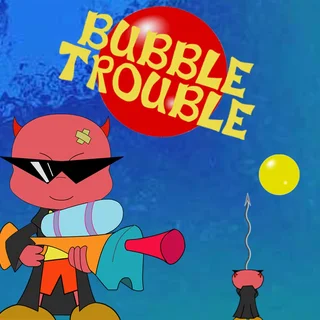
Bubble Trouble came out of Croatia in 2002, a Flash game by Kresimir Cvitanovic that Miniclip put on its front page and that then lived in every school computer lab for a decade. The idea is borrowed from the arcade game Pang and stripped to the bone: you are a small devil in a trench coat and sunglasses, the room is a stone box, and bubbles the size of your head bounce around it in long, predictable arcs. Your harpoon goes straight up. When it touches a bubble the bubble splits into two smaller bubbles that bounce lower and faster, and those split again, until the tiniest ones pop for good. The level is done when the room is empty, and it is lost when a bubble touches you or the red bar at the bottom of the screen runs out.
The version on bubbletrouble.org is the HTML5 remake the developer built himself when browsers dropped Flash, so it is the same game with the same physics and it runs on a Chromebook, a laptop or a phone. It starts you straight into level one. Two players can share the keyboard: player one on the arrow keys and space, player two on A, D and Q, both clearing the same room with separate lives and scores. The items that drop out of popped bubbles change the pace of a level: a double harpoon lets you fire twice, a hook pins the line to the ceiling so it acts as a wall, shields let you take a hit, and extra time and extra lives are exactly what they sound like. It is a simple game with a clear rhythm, and the rhythm is what keeps people coming back to it twenty years on.
Controls & mechanics
| Action | Control | Purpose |
|---|---|---|
| Move (player 1) | Left / Right arrow | Walk along the floor; you cannot jump, so positioning is everything |
| Fire (player 1) | Space | Sends a harpoon straight up from your position; it stays until it hits a bubble or the ceiling |
| Move and fire (player 2) | A / D to move, Q to fire | Second player on the same keyboard, own lives and score; keys can be changed in Settings |
| Pause and menu | Pause button, top-right | Pauses the level and opens the menu for the 1 player / 2 players modes, settings and scores |
How to get further in Bubble Trouble
- Shoot the small ones first: A big bubble is slow and easy to dodge; the small ones are what kill you. When a hit splits a bubble, finish the two halves before you go after the next big one, or the room fills with fast little bubbles you cannot walk through.
- Fire under the bubble on its way down: The harpoon takes time to climb. Stand where a bubble is going to be, not where it is, and fire as it starts to fall so the line is already there. Firing at a bubble on its way up wastes the shot and leaves you standing under it.
- Use the corners: Bubbles bounce off the side walls, so a corner is where they change direction and slow at the top of the arc. Standing a step in from a wall gives you a clean upward shot and an escape route back along the floor.
- Take the hook and double harpoon, skip the rest when it is risky: Items fall where the bubble popped, which is usually in the middle of the action. The double harpoon and the hook are worth a dash because they change the level; a points bonus is not worth a life.
Key features
- The developer's own remake: Kreso Games rebuilt Bubble Trouble in HTML5 with the original room, bubbles and physics, so it plays the way it did in 2002 without Flash.
- Two players on one keyboard: Arrow keys and space for player one, A, D and Q for player two, with separate lives and scores in the same room.
- Items that change the level: Double harpoon, hook, mines, shields, freeze and slow time, extra time and extra lives all drop from the bubbles you pop.
- Straight in: The game starts on level one when the page loads; the pause button holds the menu, settings and high scores.
Game info
- Title: Bubble Trouble
- Developer: Kresimir Cvitanovic (Kreso Games)
- Category: Bubble Poppers
- Platform: Web browser (HTML5)
- Players: 1 or 2 on the same keyboard
Pro tip: The timer bar is the real enemy on later levels, not the bubbles. Popping the biggest bubble in the room early is tempting, but it doubles the number of things bouncing at you. Work one side of the room at a time: split one big bubble, clear its halves and their halves down to nothing, then move to the next. You spend more of the bar in a single spot and far less of it running from a room full of small bubbles.
Frequently asked questions
What is Bubble Trouble?
An arcade game by Kresimir Cvitanovic, first released as a Flash game in 2002 and hosted by Miniclip. You stand at the bottom of a room, fire a harpoon straight up at bouncing bubbles, and every bubble you hit splits in two until the smallest ones pop. Clear the room before the timer runs out without letting a bubble touch you.
What are the controls?
Player one moves with the left and right arrow keys and fires with space. Player two uses A and D to move and Q to fire. The keys can be changed in the settings menu behind the pause button.
Can two people play?
Yes. Choose 2 Players from the menu and both players share the keyboard and the room, each with their own lives and score. It is co-operative: the level is cleared when the room is empty, whoever popped what.
Is this the original Flash game?
It is the HTML5 remake made by the original developer, served from this site. It keeps the same room, bubbles and physics and adds the items and settings of the later versions, and it needs no Flash or Ruffle, so it runs on phones and Chromebooks.
Why do I keep dying to small bubbles?
Because they are fast and low, and there are twice as many every time you split a bigger one. Clear the halves of each bubble you pop before you hit another big one, and stand where a bubble is going to land rather than where it is now.